

Welcome to Friday 101, the weekly series where I break down one part of the AI agent stack in plain language.
Most people have now asked an AI a question and received a useful answer. Far fewer have asked an AI to carry out a task and had it completed. The distance between those two experiences is where most of the engineering effort in AI currently sits, and closing it has little to do with making the underlying models more capable.
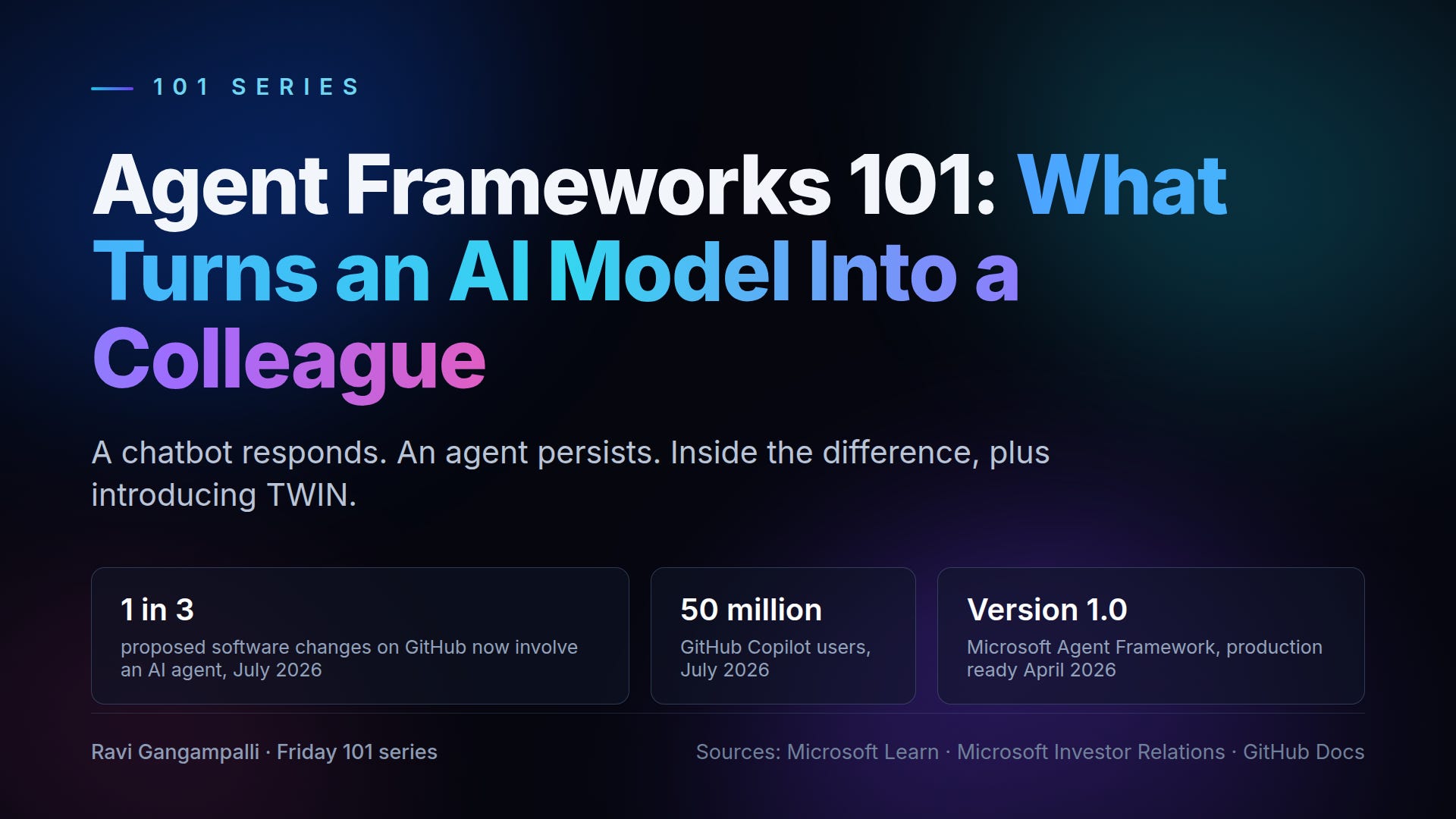
The scale is already substantial. On Microsoft’s July 29, 2026 earnings call, Satya Nadella reported that GitHub Copilot has 50 million users, that GitHub has 225 million users, and that one in three pull requests on GitHub now involves an agent. A pull request is a proposed change to a piece of software, submitted for a colleague to review before it takes effect. On the largest software platform in the world, a third of those proposals now have an agent somewhere in their history.
What an agent framework is
A language model, considered on its own, receives text and returns text. It holds no memory of previous conversations, has no access to your systems, and cannot take an action. An agent framework is the software layer built around that model to supply what it lacks: memory that persists between sessions, tools that reach real systems, rules governing which actions require human approval, and a record of what took place. Constructing an agent consists largely of building that layer. A framework provides it so that individual teams do not each rebuild it.
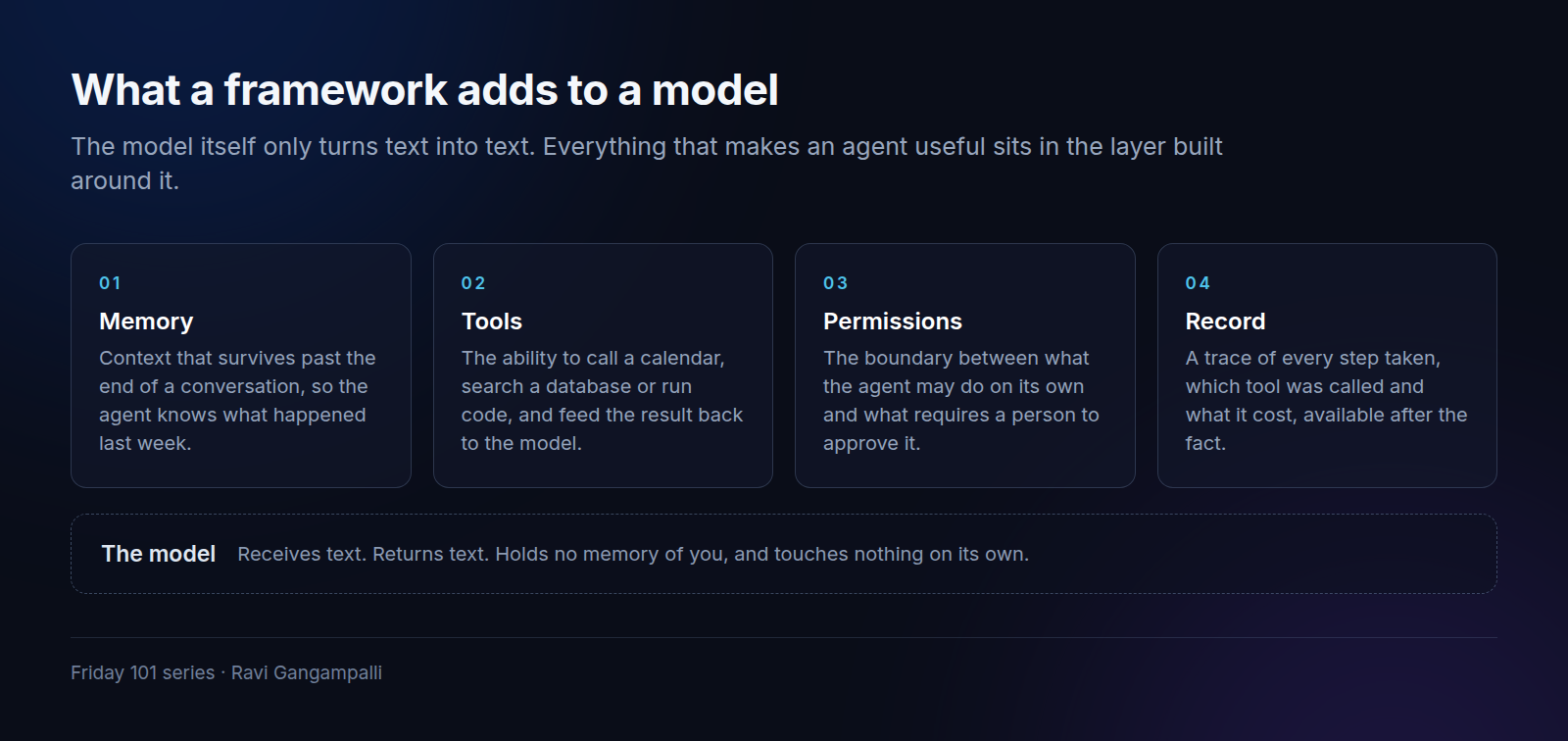
This distinction is often lost in discussions that focus on model selection. Models are increasingly interchangeable and can be substituted through configuration. The surrounding layer is where engineering effort accumulates and where meaningful differences between systems emerge.
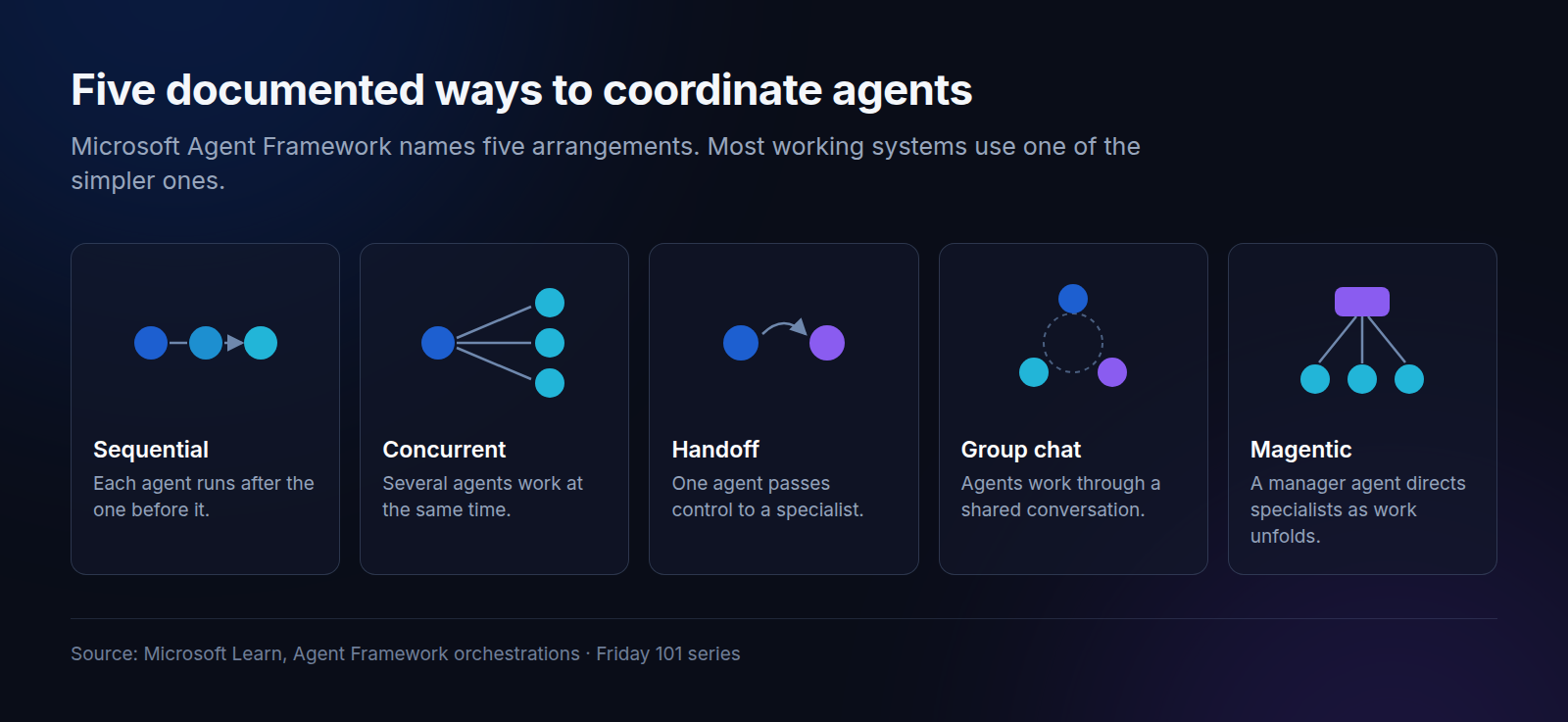
Frameworks also address coordination between agents. Microsoft Agent Framework documents five arrangements, ranging from agents running in sequence to a manager agent that directs specialists as work develops. The names are less important than the observation that the simpler arrangements are sufficient for most systems.
Microsoft Agent Framework
Microsoft Agent Framework is Microsoft’s open source toolkit for this work. It was released as a preview on October 1, 2025 and reached version 1.0 on April 2, 2026, which Microsoft describes as the production-ready release, with stable interfaces and a commitment to long-term support. It is distributed under the MIT license.
The version number carries practical significance beyond engineering teams. A preview invites experimentation and feedback, and its interfaces may still change. A 1.0 release with a support commitment is something an organisation can plan against. Both have their place, and the distinction is worth tracking on any platform an organisation intends to depend upon.
Version 1.0 also resolved a division within Microsoft’s own tooling. Two separate toolkits had existed, Semantic Kernel for enterprise development and AutoGen from Microsoft Research for multi-agent work, and teams had to choose between them. Agent Framework brings the two together, and Microsoft’s documentation describes it as the direct successor to both, developed by the same teams. Organisations with existing Semantic Kernel systems have time to plan: Microsoft committed to supporting it for at least a year after the new framework left preview, placing the floor around April 2027.
GitHub Copilot in practice
Where Agent Framework is the toolkit, GitHub Copilot demonstrates what these systems become at scale. It now spans three distinct levels of independence, from suggestions offered while a developer types, through supervised editing across multiple files, to a cloud agent that accepts an assigned task and works independently in a temporary isolated environment before returning a draft for review. That capability became generally available on September 25, 2025.
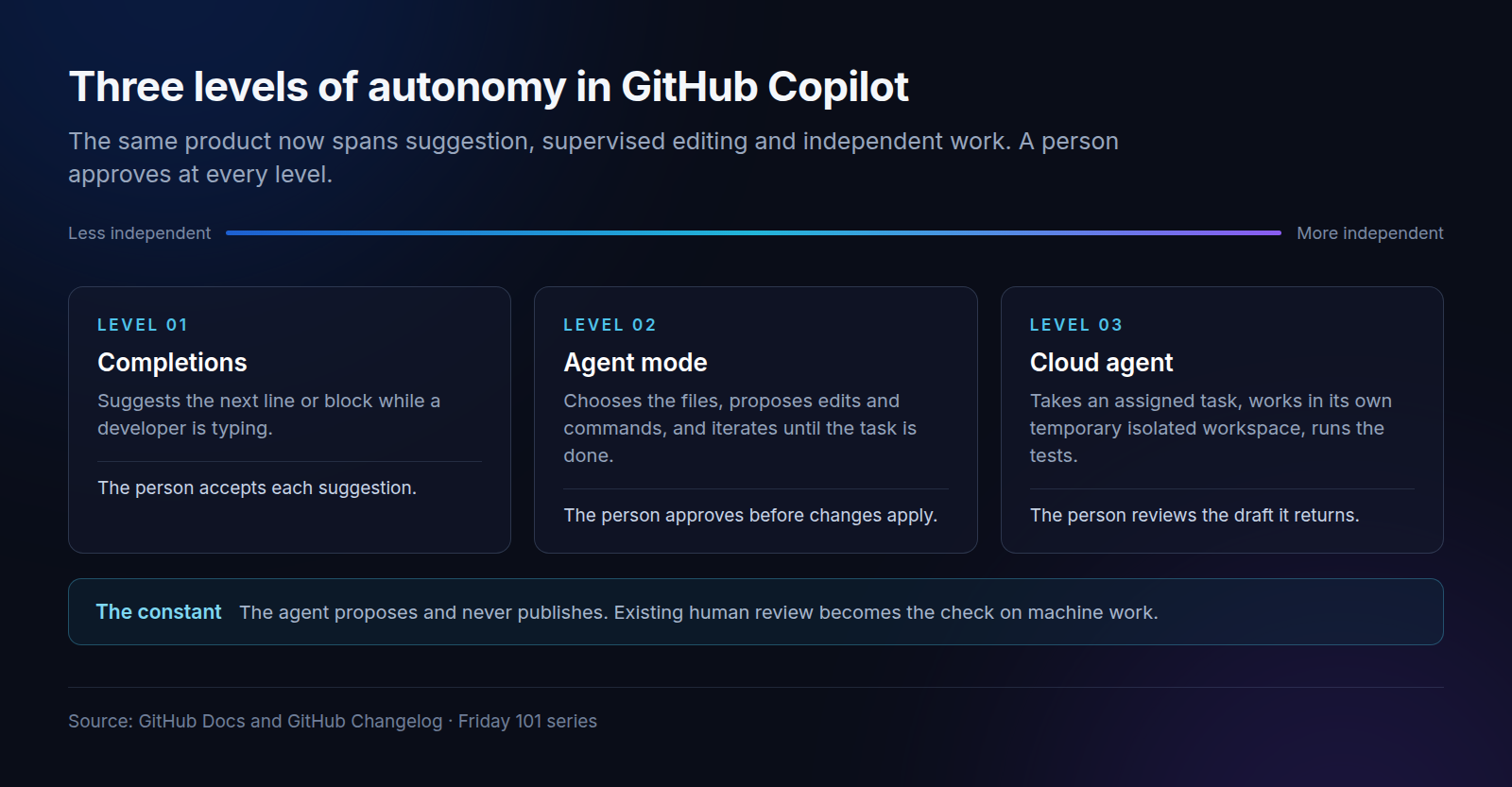
The consistent principle across all three levels is that the agent proposes rather than publishes. The review step that already governed human contributions becomes the control on machine contributions as well, which is the most portable idea in this article and applies well outside software development.
GitHub has also positioned itself deliberately as neutral ground. At its Universe conference on October 28, 2025, the company announced Agent HQ, stating that agents “shouldn’t be bolted on. They should work the way you already work.” By February 4, 2026, agents from Anthropic and OpenAI were running inside GitHub in public preview. A platform that accommodates competing agents is asserting that durable value lies in governance, review and workflow rather than in ownership of the agent itself.
An agent built on the framework
To test these ideas against something real, I built TWIN on Microsoft Agent Framework.
The motivation was narrow. Colleagues kept asking me variations of one question: which skills to develop, what becomes of their role as AI absorbs part of it, whether they are secure. My answers were informed guesses, and the answers available from a chatbot were generic. I wanted something that could examine one specific career, give a grounded read, and then stay with it.
So TWIN manages a career rather than advising on one. It applies a published assessment method across five dimensions, keeps a notebook where evidence accumulates between assessments, and evaluates new roles against that profile overnight, whether or not I am looking. It has no access to workplace chat, which was a deliberate limit rather than an oversight.
The part I regard as most important is the loop back to human mentors. An AI coach is useful for structure, preparation and follow-through, and unsuited to being the final word on a career. TWIN prepares for conversations with real mentors and records what came out of them, so that human judgment enters the same record and shapes what the agent does next. The agent maintains continuity. People supply the judgment.
That loop is not hypothetical for me. A good deal of my own development, and the direction my career has taken, came out of conversations with a few career coaches I have worked with over the years. They also reviewed the research document and the TWIN framework, and their feedback improved both. They do things in a coaching conversation that the agent cannot, and encoding some of those skills into TWIN is the next thing I am building.
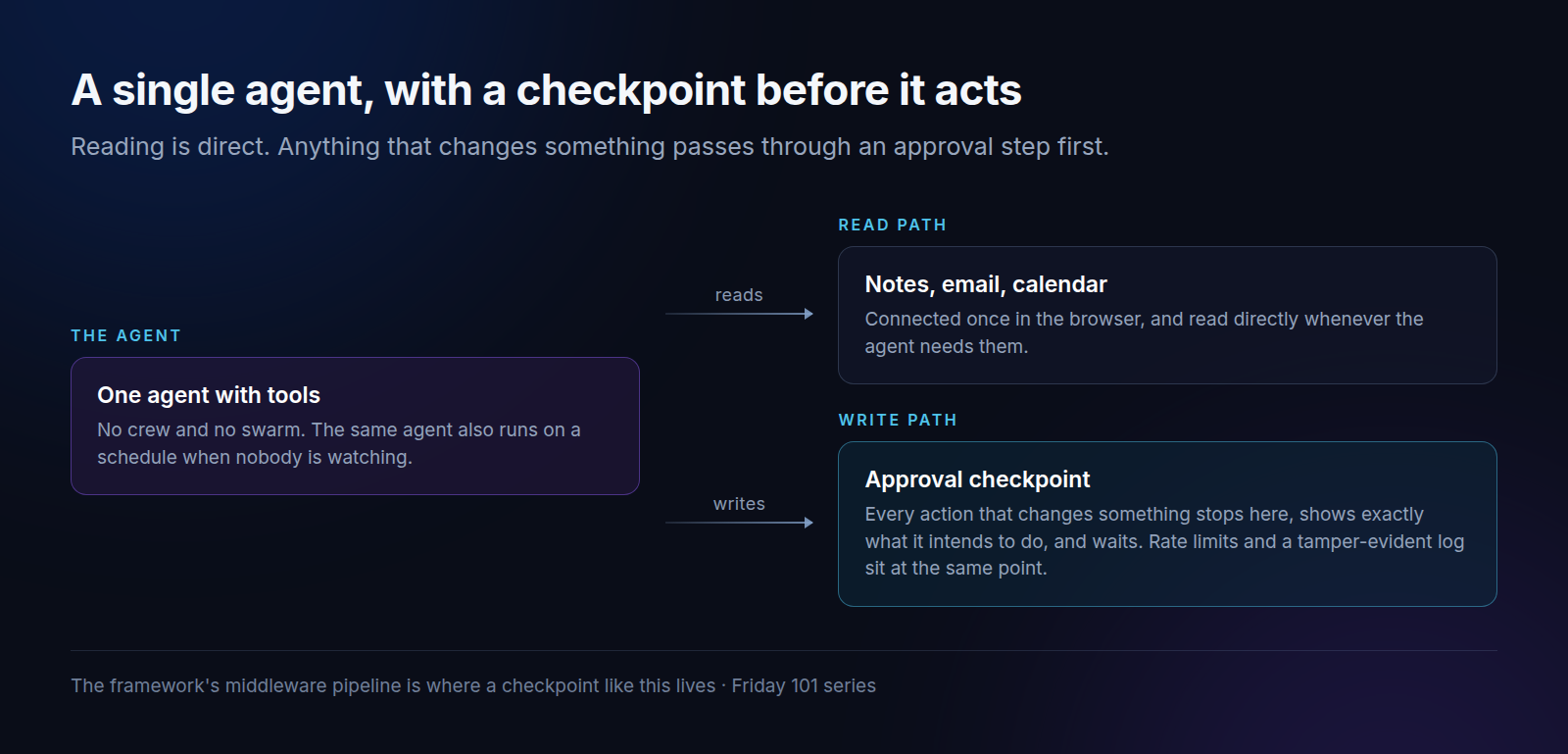
The build lesson was not the one I expected. Of the five coordination arrangements the framework documents, TWIN uses none. It is a single agent with tools, and what resembles a team is that same agent running on a schedule against different tasks. The component I would not omit is the middleware pipeline that sits in front of every tool call, because that is where the approval checkpoint lives: anything that changes something halts, shows exactly what it intends to do, and waits. Coordination proved straightforward. Governance was the substantial work, and the framework supplied the place to put it.
The framework is not tied to one model host. It will call a model running in Microsoft Foundry, one running locally, or the runtime behind an existing GitHub Copilot subscription. That last route is the practical one for most people: anyone on a Copilot plancan put a subscription they already pay for behind an agent of their own, and use it day to day.
Where the agent itself runs was a separate decision. Mine runs on my own machine because it holds my career history, encrypted, with only the model call leaving the laptop, and the same checkpoint that gates its actions also rate limits them and writes a tamper-evident log. For anything operated on behalf of other people I would deploy it as a hosted agent in Foundry, for the isolation and identity management that come with it.
TWIN is free to install and use. A few friends and I use it, and the assessment methodology is public at https://twin.coach/methodology, which is the part I would most like to see challenged.
What to do next
For those who do not write software, the most instructive exercise is to watch an agent work on a real task and pay attention to the review step rather than the generation step. That is where the practical character of the technology becomes apparent.
For those leading teams, three questions are worth asking: where an agent’s output enters human review, what can be reconstructed afterwards about what it did and what it cost, and which capabilities under consideration are generally available rather than in preview.
For those building, the sensible course is to begin more simply than seems necessary and to rely on what the framework already provides. The coordination patterns are a menu rather than a target.
Next Friday: agent memory, and why an agent that remembers the wrong things is less useful than one that remembers nothing.
The Friday 101 series is part of Proxperity.ai, where I build and write about practical AI agents. Subscribe to get every explainer by email.
A note on this article: I wrote this in a personal capacity and it reflects my own views, not an official Microsoft communication. All details are drawn from public documentation and official materials as of the publication date. If anything becomes outdated as the platform evolves, tell me in the comments and I will keep it corrected.
Sources:
https://www.microsoft.com/en-us/investor/events/fy-2026/earnings-fy-2026-q4
https://learn.microsoft.com/en-us/agent-framework/overview/
https://azure.microsoft.com/en-us/blog/introducing-microsoft-agent-framework/
https://devblogs.microsoft.com/agent-framework/microsoft-agent-framework-version-1-0/
https://devblogs.microsoft.com/agent-framework/semantic-kernel-and-microsoft-agent-framework/
https://learn.microsoft.com/en-us/agent-framework/workflows/orchestrations/
https://learn.microsoft.com/en-us/agent-framework/agents/middleware
https://learn.microsoft.com/en-us/agent-framework/agents/providers/github-copilot
https://docs.github.com/en/copilot/how-tos/copilot-sdk/integrations/microsoft-agent-framework
https://github.blog/changelog/2025-09-25-copilot-coding-agent-is-now-generally-available/
https://docs.github.com/en/copilot/concepts/agents/cloud-agent/about-cloud-agent
https://github.blog/news-insights/company-news/welcome-home-agents/
https://github.blog/news-insights/company-news/pick-your-agent-use-claude-and-codex-on-agent-hq/
https://twin.coach/methodology